Attic Ventilation Installation for Kuna, ID Homes
Attic ventilation in Kuna, ID balances airflow to prevent heat buildup in summer and moisture accumulation in winter, both of which compromise roof lifespan and energy efficiency. Proper ventilation systems combine intake vents along eaves with exhaust vents at the roof ridge to create continuous airflow. Homeowners often discover inadequate ventilation during roof inspections or when addressing premature shingle failure.
How does proper ventilation protect roofing systems?
Proper ventilation protects roofing systems by reducing attic temperatures that accelerate shingle aging and by expelling moisture that rots wood framing and insulation.
Summer attic temperatures can exceed 150 degrees Fahrenheit without adequate ventilation, causing asphalt shingles to dry out and lose protective granules. Winter moisture from household activities condenses on cold roof decks, leading to mold growth and structural decay. Balanced intake and exhaust airflow maintains attic temperatures closer to outdoor ambient levels, extending material life and preserving structural integrity.
Ice dams form when warm attic air melts snow on the roof, which then refreezes at colder eaves, forcing water under shingles. Effective ventilation prevents this cycle by keeping the entire roof surface at a uniform temperature.
What types of vents work best for Kuna's climate?
Ridge vents combined with soffit intake vents work best for Kuna's climate by providing continuous airflow along the entire roof length without relying on wind direction.
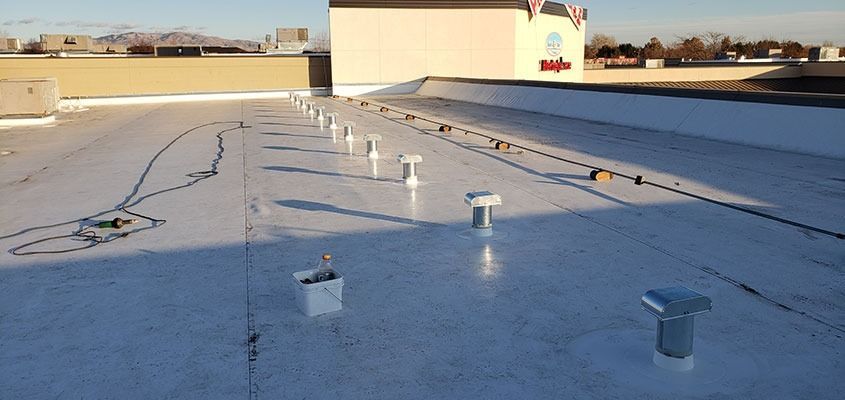
Ridge vents sit at the roof peak and allow hot air to escape naturally through convection, while soffit vents draw cooler air in from the eaves. Box vents and turbine vents offer supplemental exhaust capacity for roofs with complex geometries or limited ridge length. Gable vents provide cross-ventilation in attics with adequate end-wall access but are less effective than ridge-and-soffit systems.
Each vent type must be sized according to attic square footage and local building codes to achieve proper airflow rates. Homeowners looking to find roof repair solutions in Kuna often address ventilation deficiencies during repair projects to prevent recurring issues.
Can ventilation be improved in existing homes?
Ventilation can be improved in existing homes by adding or upgrading intake and exhaust vents without major structural modifications.
Soffit vents can be retrofitted by cutting openings in existing eaves and installing perforated panels or continuous vent strips. Ridge vents require removing a narrow section of shingles along the roof peak and cutting a slot in the decking to allow airflow. Baffles installed between rafters ensure insulation does not block soffit vents, maintaining clear airflow paths to the ridge.
Upgrading ventilation during re-roofing projects minimizes labor costs and ensures seamless integration with new roofing materials. Most ventilation improvements in Kuna are completed within one day, delivering immediate benefits in temperature control and moisture management.
How does Kuna's rural setting influence ventilation needs?
Kuna's rural setting features larger lot sizes, agricultural surroundings, and fewer obstructions that affect natural airflow patterns around homes.
Open landscapes allow prevailing winds to enhance passive ventilation, but also expose roofs to dust and debris that can clog vents if not properly screened. Homes near irrigated fields experience higher humidity levels during growing seasons, increasing the importance of effective moisture expulsion. Older rural homes may lack modern ventilation standards, requiring retrofits to meet current performance expectations.
Contractors familiar with Kuna's rural environment design ventilation systems that account for local wind patterns, dust exposure, and seasonal humidity variations. Proper ventilation supports both roof longevity and indoor comfort in Idaho's diverse climate.
Madison Roofing installs attic ventilation including intake and exhaust vents to prevent heat buildup, moisture damage, and ice dams, protecting roof integrity throughout Kuna. Plan tailored maintenance programs in Kuna to ensure ventilation systems remain effective over time.